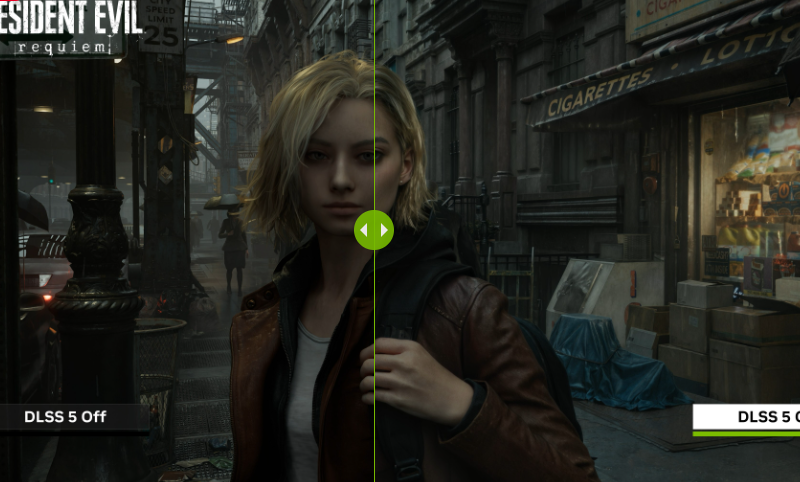
NVIDIA DLSS 5 neural rendering is the most significant computer graphics breakthrough since real-time ray tracing in 2018 — rebuilding game lighting, skin, hair, and materials with AI in real time at 4K. Here is everything confirmed so far, including all 16 supported games.
NVIDIA DLSS 5 Neural Rendering Explained: The Graphics Leap That Makes PC Games Look Like Real Life
NVIDIA DLSS 5 neural rendering was officially unveiled at GTC 2026 on March 16, and the announcement hit differently from a typical product reveal. Jensen Huang, NVIDIA’s CEO, called it “the GPT moment for graphics” — a comparison that is bold but, once you actually understand what DLSS 5 does under the hood, hard to argue with. This is not a frame rate tool. It is not an upscaler. It is a real-time AI system that looks at a game’s rendered frame and rewrites the way every surface, every light source, and every material looks — in the 16 milliseconds your GPU has to produce a frame during live gameplay.
Twenty-five years ago, NVIDIA invented the programmable shader. Eight years ago, they brought real-time ray tracing to consumer hardware. DLSS 5 is the next line in that timeline, and the technology community, the game development world, and Digital Foundry — arguably the most credible technical game analysis team working today — all came away from the first hands-on previews calling it one of the most impressive things they had seen.
Here is everything you need to know: what it does, how it works, why it matters, which games are getting it, and what you need to run it.
The Gap That DLSS 5 Is Finally Closing
To appreciate why DLSS 5 is a genuine landmark, you need to understand the problem it was built to solve — because it is a problem that has existed since the first 3D game ever ran in real time.
Hollywood visual effects artists have effectively unlimited time to make things look real. A single frame of high-end CGI — with accurate global illumination, subsurface light scattering on skin, physically correct reflections across fabric and hair, and realistic shadow behavior — can take anywhere from minutes to hours to render on a server farm. The results are stunning precisely because there is no computational limit per frame. The machine just keeps working until the frame looks right.
A game running at 60 frames per second gets 16 milliseconds per frame. Everything — geometry, lighting, textures, shadows, reflections, post-processing, physics, and the rest — has to land in that window. No exceptions. NVIDIA has dramatically expanded what is possible inside that window over the decades, delivering a 375,000x increase in compute from the original GeForce to the RTX 5090. Despite all of that horsepower, a real-time rendered frame still looks like a game frame, not a film frame. The gap between the two cannot be closed through brute force alone.
DLSS was always NVIDIA’s attempt to work smarter rather than harder. DLSS 1 and 2 used AI to upscale resolution from lower-resolution inputs, giving the GPU less work to do while maintaining output quality. DLSS 3 generated entirely new frames to push frame rates higher. DLSS 4.5, released at CES in January 2026, took that further — using a second-generation transformer model and a 6x Multi Frame Generation mode that generates 23 out of every 24 pixels you see on screen using AI rather than direct rendering.
All of those versions were focused on the same goal: performance. More frames, sharper image, less GPU load.
DLSS 5 does something categorically different. It stops asking how to make the game run faster and starts asking how to make what the game renders look more like reality.
=> Your games are about to look like they were rendered in Hollywood. DLSS 5 is coming this fall — make sure your GPU is ready.

How DLSS 5 Actually Works
Here is the mechanics in plain terms — no engineering degree required.
When your GPU renders a frame in a DLSS 5-enabled game, the standard rasterization pipeline runs exactly as normal. The game looks the way the developers made it look. DLSS 5 then receives two inputs from that rendered frame: the color information — the actual pixel colors of the scene — and the motion vectors, which describe how things in the frame are moving from one moment to the next.
An AI model takes those two inputs and passes them through a neural network that has been trained end-to-end to understand what different types of scenes should look like in the physical world. It has learned how skin actually responds to different lighting conditions — how light scatters beneath the surface, creating the warm, living quality that separates a human face from a wax dummy. It has learned how hair catches and diffuses light from different angles. It knows the difference between the sheen of silk and the texture of rough cotton. It understands what a face looks like under direct sunlight versus overcast diffuse light, what a backlit subject looks like when the scene behind them is bright, and how shadows fall on different types of ground surfaces.
Armed with that understanding, the neural model rebuilds the lighting and material detail of the scene to match what it would actually look like under physically correct conditions — not through ray tracing, not through any additional rendering work on the game side, but purely through AI inference applied to the existing frame. The structure of the scene remains exactly what the developers built. The characters are in the same positions, the environments are unchanged, the geometry is identical. But the way light falls on all of those surfaces, and the way each material responds to that light, gets rebuilt to a qualitatively different standard.
Critically for game developers, the output is deterministic and temporally stable. That means it looks the same every time given the same input, and it does not flicker, ghost, or produce artifacts from one frame to the next. This is what separates it from generative video AI models, which produce different outputs for identical inputs and are completely unsuitable for real-time interactive content. The game developer retains precise control through intensity sliders, color grading tools, and masking options — deciding exactly where and how DLSS 5 enhancements are applied without losing the game’s artistic identity.
What Hands-On Testing Actually Showed
The most credible early assessment of DLSS 5 came from Digital Foundry, which got hands-on access at GTC 2026 and described it as one of the most impressive technical demonstrations they had encountered.
Their observations in Starfield were specific and useful. A character’s jacket — previously decent-looking but clearly digital — showed markedly improved specular response under DLSS 5. The lamp post in the background became “much more convincingly reflective.” The character’s face showed proper subsurface scattering for the first time, with correct shadow behavior around the eyes, teeth, and mouth that simply did not exist in the base render. Even simpler objects like a coffee maker in a scene showed noticeably improved material response.
The observer’s own words are worth quoting because they are unusually direct for technical coverage: “All of a sudden you’ve got this game that otherwise looks very flat, otherwise has a kind of last generation appearance in some respects, and all of a sudden it looks dramatically better. The material properties along her clothing, and indeed her face, show a colossal increase in lighting fidelity where all of a sudden you’re seeing proper subsurface scattering.”
In Hogwarts Legacy, materials like stone, aged wood, and fabric gained tactile depth that the original rendering could not achieve. Surfaces that previously looked like flat painted textures began to behave the way those materials behave when physical light hits them. In Resident Evil Requiem, the atmosphere of the horror scenes deepened noticeably because lighting and shadow became more physically convincing throughout.
To be fair, not every reaction was uniformly positive. PC Gamer raised a legitimate artistic concern: in some footage, DLSS 5 altered the lighting tone and atmosphere of a scene in ways that deviated from the developer’s original artistic intent — a wood elf character in particular looked noticeably different in ways the developer had not chosen.
This is a real tension that the technology will need to navigate as it rolls out into full production. NVIDIA’s developer controls for masking and intensity are specifically designed to let studios manage this, but it will require careful integration work on the game side to ensure DLSS 5 enhances rather than overrides what the artists built.
Every Game Confirmed for DLSS 5
NVIDIA confirmed the first 16 titles receiving DLSS 5 support. These are all RTX 50-series-exclusive implementations coming this fall:
-
AION 2
-
Assassin’s Creed Shadows
-
Black State
-
CINDER CITY
-
Delta Force
-
EA SPORTS FC
-
Hogwarts Legacy
-
Justice
-
NARAKA: BLADEPOINT
-
NTE: Neverness to Everness
-
Phantom Blade Zero
-
Resident Evil Requiem
-
Sea of Remnants
-
Starfield
-
The Elder Scrolls IV: Oblivion Remastered
-
Where Winds Meet
Publishers confirmed as DLSS 5 partners include Bethesda, Capcom, Hotta Studio, NetEase, NCSOFT, S-GAME, Tencent, Ubisoft, and Warner Bros. Games. Given the size of those publishers’ game libraries, the number of confirmed titles is expected to grow considerably before the fall launch window
The developer quotes from the launch announcement are worth reading in full because they reflect genuine enthusiasm from studios that have actually worked with the technology in their own games. Todd Howard at Bethesda described DLSS 5 running in Starfield as seeing “the artistic style and detail shine through without being held back by the traditional limits of real-time rendering.” Jun Takeuchi at Capcom connected it directly to what makes the Resident Evil series work: creating experiences that feel “cinematic, compelling and deeply believable — where every shadow, texture and ray of light is crafted with intention.” Charlie Guillemot at Vantage Studios said it “changes what we can promise to players” when building worlds like the one in Assassin’s Creed Shadows.
How DLSS 5 Relates to DLSS 4.5 and What Comes With Both
A common question since the announcement is whether DLSS 5 replaces DLSS 4.5. The answer is no, and understanding why clarifies what each technology is actually doing.
DLSS 4.5 is a performance technology. Its job is to give you more frames at higher quality with less GPU work. The second-generation transformer model in DLSS 4.5 delivers sharper Super Resolution than any previous version. The 6x Multi Frame Generation mode lets RTX 50-series GPUs generate five additional frames for every one rendered frame, pushing frame rates dramatically higher. In a recent blind gaming test conducted by Tom’s Guide, 48% of players chose DLSS 4.5 output as their preference over both AMD FSR and native rendering — the highest preference rate in a blind test of any DLSS version.
DLSS 5 is a visual fidelity technology. Its job is to make the frames you are already rendering look significantly more real.
In practice, a game running DLSS 5 is likely running DLSS 4.5 alongside it — getting higher frame rates through Multi Frame Generation and getting better-looking frames through DLSS 5’s neural rendering. The two layers stack. One makes the game run faster. The other makes it look better. Both are happening at the same time.
NVIDIA integrates DLSS 5 through the same Streamline framework developers already use for DLSS 4.5 and Reflex, which simplifies the technical lift on the game side considerably. Studios do not need to build new integration pipelines — they extend ones they have already built.
What You Need to Run DLSS 5
This part is clear and there are no exceptions: DLSS 5 requires an NVIDIA GeForce RTX 50 series GPU.
It does not run on RTX 40 series, RTX 30 series, or any earlier hardware. The AI model that powers DLSS 5 requires the Tensor Core architecture and compute density available in the 50-series cards, and there is no path to retrofitting it onto older generations. If you are currently on a 40-series card, DLSS 4.5 continues to deliver excellent performance results, but DLSS 5’s visual fidelity enhancements are not available to you.
If you are building a new gaming PC this year and visual realism matters to you, DLSS 5 arriving this fall is a compelling reason to make sure your GPU is RTX 50-series hardware. The 15-game launch list already covers some of the biggest titles people are actively playing — Starfield, Hogwarts Legacy, Assassin’s Creed Shadows, Resident Evil Requiem, Elder Scrolls IV Oblivion Remastered — and that list is growing.
Why This Matters Beyond the Technical Details
NVIDIA has made major architectural leaps before. Programmable shaders in 2001 changed what games could look like. CUDA in 2006 changed what GPUs could be used for. Real-time ray tracing in 2018 changed how light was handled in games. Each of those was a platform shift that developers built toward for years after the hardware landed.
DLSS 5 has the same shape. The fall 2026 launch will be the beginning of an adoption curve, not its peak. Games shipping in 2027 and 2028 that are built from the ground up with DLSS 5 in the design pipeline — rather than retrofitted onto existing titles — will likely show what the technology is truly capable of when artists and developers treat it as a core part of their visual approach rather than a post-process add-on.
Jensen Huang’s GPT comparison at GTC was deliberate. When GPT-3 launched, it was impressive but rough in places. GPT-4 and its successors showed what the underlying approach could eventually deliver as models improved and developers built around them. DLSS 5 is in that early phase. The foundation is in place. What gets built on top of it over the next few years is the part worth watching.
DLSS Version Comparison at a Glance
FAQ
What is NVIDIA DLSS 5?
DLSS 5 is a real-time neural rendering model that takes a rendered game frame and uses a trained AI model to rebuild its lighting and material detail to look photoreal — the same quality standard previously only achievable in offline Hollywood visual effects rendering.
When does DLSS 5 come out?
DLSS 5 arrives in fall 2026. NVIDIA previewed the technology at GTC 2026 in March and is continuing optimization before launch.
Which games support DLSS 5?
Sixteen games are confirmed so far, including Starfield, Resident Evil Requiem, Hogwarts Legacy, Assassin’s Creed Shadows, The Elder Scrolls IV: Oblivion Remastered, Delta Force, NARAKA: BLADEPOINT, Phantom Blade Zero, and others. The list is expected to grow significantly before launch.
Do I need an RTX 50 series GPU for DLSS 5?
Yes. DLSS 5 is exclusive to RTX 50 series hardware. It does not run on RTX 40, 30, or earlier series cards.
Is DLSS 5 the same as ray tracing?
No. DLSS 5 does not add ray tracing to a game. It uses an AI model trained to understand how light and materials behave, and applies that understanding to improve the appearance of an existing rendered frame — achieving a different path to more realistic visuals.
Does DLSS 5 replace DLSS 4.5?
No. DLSS 4.5 handles performance through frame generation and super resolution. DLSS 5 handles visual fidelity through neural rendering. Both run simultaneously in supported games — one makes the game faster, the other makes it look better.
What is the difference between DLSS 5 and generative video AI?
Generative video AI models produce different outputs each time for the same input and run offline. DLSS 5 is deterministic and temporally stable, meaning it produces consistent results frame to frame in real time, and it is tightly grounded in the game’s 3D source data and artistic intent.
DLSS 5 is not incremental progress. It is the kind of technology shift that makes you look back in a few years and remember where the line was crossed. The gap between game graphics and real-world visual quality has been closing for decades through raw compute. DLSS 5 closes it differently — through understanding. If you are planning a PC build and games matter to you, making sure you are on RTX 50-series hardware before fall 2026 puts you right at the front of that shift when it arrives.
=> Photoreal lighting. Real skin. Real materials. All in real time. See what DLSS 5 does to your favorite games — and get RTX 50 series now.