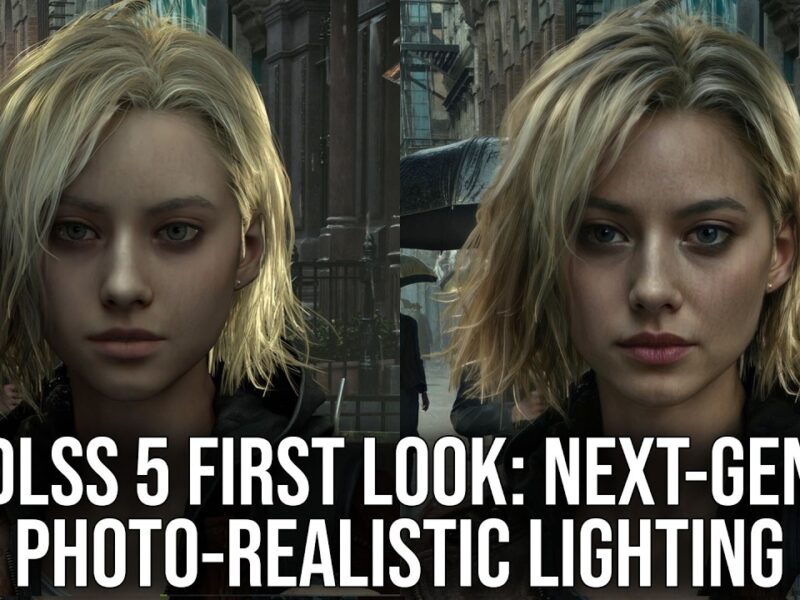
DLSS 5 photorealistic lighting for RTX 50 series just got its most credible real-world test yet — Digital Foundry went hands-on with four games at GTC 2026 and called it one of the most impressive demos they have ever seen. Here is the full breakdown of what the technology does, what they actually observed, and what concerns were raised.
DLSS 5 Photorealistic Lighting RTX 50 Series: What Digital Foundry’s Hands-On Actually Revealed
DLSS 5 photorealistic lighting for RTX 50 series got its first proper real-world testing at GTC 2026, and the most credible technical outlet in PC gaming had their team on the ground with four games running live DLSS 5 builds. Digital Foundry — the team at Eurogamer known for the most rigorous frame-rate analysis and graphics testing in the industry — walked away describing the experience as one of the most impressive technical demonstrations they have seen. But they also raised a concern that is worth taking seriously, one that cuts to the heart of a genuine tension in what DLSS 5 does.
This is not a summary of NVIDIA’s press release. This is what actually happened when independent hands got on the technology and put it next to known games in real time. Here is everything observed, explained, and honestly assessed.
Who Digital Foundry Is and Why Their Opinion Matters Here
For anyone not already deep in PC hardware coverage, it is worth spending a sentence on why Digital Foundry’s take on this carries weight. They are the team that invented the practice of systematic frame-time analysis for video games. Their methodology — capturing footage from multiple platforms, running pixel-by-pixel comparisons, measuring real-world performance under controlled conditions — became the industry standard for how games media covers technical performance. Game developers, GPU engineers, and platform holders all take their analysis seriously in ways they do not take most gaming press.
When Digital Foundry calls something one of the most impressive technical demos they have encountered, that is not hyperbole for clicks. It is a considered statement from people who have tested hardware and software professionally for two decades. And when they also raise concerns about what the technology does to character appearance, those concerns deserve the same weight.
=> Digital Foundry called it one of the most impressive demos they have ever seen. Find out what DLSS 5 actually looks like in real games — and make sure your GPU is ready for fall 2026.


The Four Games They Tested and What They Found
NVIDIA gave Digital Foundry access to four games running with DLSS 5 enabled during the GTC 2026 event in San Jose. The titles were Starfield, Hogwarts Legacy, Assassin’s Creed Shadows, and The Elder Scrolls IV: Oblivion Remastered, alongside a dedicated Zorah tech demo that NVIDIA built specifically to showcase what the technology can do in a purpose-built scene.
Starfield
Starfield was the game where the before-and-after comparison was most immediately striking for the Digital Foundry team. Their description focused on a specific scene featuring a character named Grace, and the observations were detailed and concrete.
In the base render, Grace’s jacket looked acceptable but clearly digital — a flat material without much response to the scene’s lighting. Under DLSS 5, the specular response of the jacket changed meaningfully, showing the kind of light-catching behavior that physically accurate fabric has in reality. The lamp post behind her in the background went from looking like a decent texture to looking “much more convincingly reflective” — the team’s exact words. Her face showed proper subsurface scattering for the first time, meaning the light entering the surface of her skin scattered the way it does with real human tissue rather than bouncing off it like painted plastic.
The overall effect was described as transforming a scene from something that “looks very flat, otherwise has a kind of last generation appearance in some respects” to something “dramatically better.” The lighting fidelity increase around the face — specifically around the eyes, teeth, and mouth — was “colossal” in their description.
Here is where the concern enters, though. In a close-up of Grace’s face, the DLSS 5 version did not look like Grace with better lighting. It looked like a different version of Grace — smoother, lighter in complexion, with altered facial proportions in ways the original artists did not design. The character’s distinctive appearance was changed by the AI model’s idea of how a photorealistic version of a human face should look in that lighting condition. That is not a small issue.
Hogwarts Legacy
In Hogwarts Legacy, the results were less character-specific and more environment-focused, and the team found them notably more uniformly positive. Stone floors, worn wooden furniture, aged tapestries, and brick walls showed a tactile depth that the original rendering never achieved. The way material surfaces responded to the light in the scene — the difference between the dull roughness of stone and the shinier quality of polished wood — was clearly enhanced.
For environment-heavy scenes, where there is no character identity to accidentally alter, DLSS 5′s material improvements landed cleanly and without any of the artistic tension that showed up in character-specific testing.
Oblivion Remastered and Assassin’s Creed Shadows
In Oblivion Remastered, the results were described as making characters look “far more realistic” with consistent improvements to subsurface scattering and lighting interactions. In Assassin’s Creed Shadows, foliage showed noticeably enhanced depth and light dynamics — leaves catching and scattering light the way real vegetation does rather than looking like painted geometry.
One hands-on assessment from Ryan Shrout, a trusted voice in GPU analysis, described the Assassin’s Creed Shadows foliage as a standout. In a scene with a clearing and tree cover, the interaction between light and individual leaves created a sense of depth and naturalism that the base render did not come close to achieving. The improvement was visible and immediate, with no need for side-by-side comparison to notice the difference.
The Zorah Tech Demo
The purpose-built Zorah demo was a massive courtyard scene specifically designed by a dedicated NVIDIA team to showcase what DLSS 5 can do when developers build with the technology in mind from the start rather than applying it to an existing game. The results here were broadly considered the most impressive of the four tests.
The subsurface scattering on plant life in the courtyard rivaled what was being achieved on character faces — showing that the AI model’s understanding of light interaction with organic material extends beyond human skin to plant tissue, which scatters and transmits light in similarly complex ways. The overall lighting environment of the courtyard felt genuinely different from anything achievable in standard real-time rendering.
How the Technology Actually Works — The Technical Layer
Digital Foundry’s coverage included a technical explanation that is worth walking through carefully, because it addresses some of the questions that emerged immediately from the community after the announcement.
DLSS 5 operates on a per-pixel basis. The AI model receives the color data and motion vectors from a rendered frame and processes them through a neural network trained end-to-end to understand the content of the scene — what type of surface each pixel belongs to, what the lighting environment is, and how that surface should respond to that lighting.
The model has been trained specifically on the kinds of scene semantics that determine visual realism: the behavior of translucent skin, the micro-geometry of hair strands catching and scattering light at different angles, the sheen of fabric under different lighting conditions, and the way environmental light — whether from a direct sun, a backlit window, or an overcast sky — determines the contrast and color of everything it hits.
One of the most technically significant aspects is that the model is unified. It does not require individual training for each game title or each type of object. The same model that handles Grace’s face in Starfield is the same model that handles foliage in Assassin’s Creed Shadows, stone floors in Hogwarts Legacy, and courtyard plants in Zorah. The model processes the raw frame data and applies the appropriate enhancement based on its trained understanding of what each type of surface is.
The output is deterministic — meaning the same input frame always produces the same output. This is not obvious and it is not guaranteed by default when you use AI models for image generation. Standard generative models have randomness built in, which is fine for creating one-off images but completely unusable in a game where every frame must be consistent with the frames around it. The deterministic property is what makes DLSS 5 viable as a real-time technique rather than an offline post-processing step.
The output is also temporally stable — meaning successive frames look consistent with each other and do not flicker, ghost, or produce the kind of shimmering artifacts that plagued earlier AI upscaling techniques. This stability comes from the motion vector input that tells the model how the scene is moving from frame to frame, letting it maintain consistent material properties across rapid camera and object movement.
The Artistic Concern That Deserves Honest Discussion
PC Gamer’s response to the same Digital Foundry footage raised a concern that the community quickly amplified, and it is a legitimate one.
In the Starfield footage, Grace under DLSS 5 does not look like Grace. She looks like the AI’s interpretation of a photorealistic human with Grace’s general hair and clothing. Her skin tone is lighter. Her face is smoother. The specific combination of features the original artists designed to make her look the way she does got softened, altered, and in some ways replaced by the model’s generalized idea of what a realistic face looks like under those lighting conditions.
This is not a trivial issue. Game characters are artistic creations. The way Grace looks was a deliberate choice made by Bethesda’s art team. If DLSS 5 changes that — even in pursuit of more photoreal lighting — it is changing the developer’s intended output without their explicit control over the specific result.
NVIDIA’s response to this concern is the developer toolkit. DLSS 5 includes controls for intensity, color grading, and spatial masking. Developers can reduce DLSS 5’s influence on specific elements of the frame, apply it selectively to environments while leaving characters at lower enhancement levels, or use masking to protect specific character features from being altered by the model.
The technical answer is reasonable. The practical question is whether game studios will have the time, resources, and integration depth to use those controls well across every scene in a large open-world game or a horror title where specific character appearances carry emotional weight. In games built from the ground up with DLSS 5 as part of the pipeline — like the Zorah demo was — the results are more uniformly impressive because artists designed around what the model does. In games where it is layered on top of a completed title, the integration work needed to avoid unintended changes is more significant.
Club386’s assessment put it plainly: “The improvements to subsurface scattering are readily apparent side by side, with her washed-out clay-like skin showing visible improvement — but there’s still an element of unintended character alteration at play.” That balance between clear material improvement and unwanted character change is the tension that DLSS 5 needs to resolve through both technical refinement and developer tooling before it reaches consumers this fall.
What Needs to Happen Before Fall 2026
Digital Foundry was clear that their hands-on was a snapshot of technology still in active development, and NVIDIA acknowledged the same. The current DLSS 5 demos required two RTX 5090 cards to run in real time — an indication that the model still needs significant optimization work before it can operate on single-card consumer hardware at playable frame rates.
That optimization work is happening in parallel with the fall 2026 launch timeline, and it is the normal trajectory for technologies of this kind. The underlying capability is clearly real. The results in purpose-built scenes are genuinely impressive, and even in retrofitted titles the material improvements to environments and non-character surfaces are largely clean. The character rendering issue is real but addressable through the controls NVIDIA has built in.
The remaining months of development will likely focus on reducing the computational requirements to single-card performance, tightening the temporal stability on fast-moving scenes, and refining the masking and intensity controls to make character-safe integration easier for developers. Whether all of that lands in clean form by fall will determine whether DLSS 5 launches as a polished feature or as a compelling but rough first generation.
FAQ
What did Digital Foundry think of DLSS 5?
Digital Foundry described DLSS 5 as one of the most impressive technical demonstrations they had seen at GTC 2026, with standout results in environment and material rendering across all four tested games. They also raised a legitimate concern about unintended changes to character appearance in existing titles.
Does DLSS 5 change what game characters look like?
Yes, in some cases. In Starfield, the test character Grace appeared lighter-skinned and smoother-featured under DLSS 5 than the original artists intended. NVIDIA provides masking and intensity controls to let developers manage this, but the results depend on how carefully studios use those tools.
What games did Digital Foundry test DLSS 5 with?
The four games were Starfield, Hogwarts Legacy, Assassin’s Creed Shadows, and The Elder Scrolls IV: Oblivion Remastered, plus a purpose-built Zorah tech demo created by NVIDIA specifically for DLSS 5 showcasing.
Is DLSS 5 ready to run on a single RTX 50 series GPU?
Not yet in its current development state. The GTC 2026 demos required two RTX 5090 cards to run in real time. NVIDIA is continuing optimization work toward the fall 2026 launch, when it is expected to run on single-card setups.
How is DLSS 5 different from a simple image filter?
A filter applies the same mathematical operation to every pixel regardless of what it represents. DLSS 5 uses a neural model that understands scene content — differentiating between skin, hair, fabric, foliage, and stone — and applies tailored material and lighting improvements to each surface type based on that understanding. The output is also deterministic and temporally stable, meaning it remains consistent across frames during live gameplay.
Will DLSS 5 be available for older RTX cards?
No. DLSS 5 is exclusive to RTX 50 series hardware. The model requires the Tensor Core density available in the 50-series architecture and will not run on RTX 40, 30, or earlier generation cards.
When does DLSS 5 launch?
Fall 2026, for RTX 50 series GPUs. The full list of supported games at launch continues to grow from the initial 16 confirmed titles.
Digital Foundry’s reaction to DLSS 5 is the most credible early signal we have about what the technology can actually do outside of NVIDIA’s own marketing. The results are genuinely impressive — especially in environments and scenes where the material and lighting improvements are clear without the complication of character identity. The character rendering concern is real, but it is solvable through the developer tools NVIDIA has already built. If you are planning an RTX 50 series GPU purchase for this fall, DLSS 5 is one of the clearest reasons to be excited about what that hardware can do once the technology ships in its final form. Get the hardware ready — the software is coming.
=> Photoreal skin. Real fabric. Light that behaves like light. DLSS 5 is coming this fall for RTX 50 series only. Get yours before they sell out.