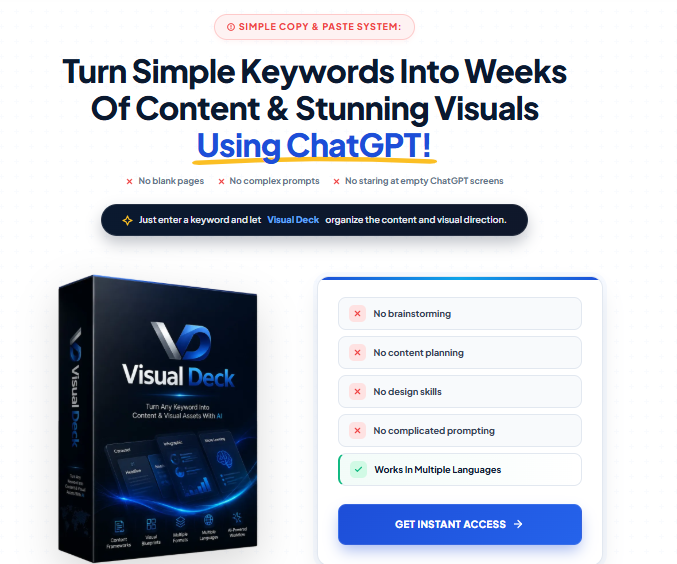
Visual Deck is a ChatGPT-powered content and visual asset generation system by RootPixel that turns any keyword into fully structured carousels, infographic frameworks, and micro-learning visual blueprints — with content direction, design guidance, and layout strategy — in minutes, no brainstorming or design skills required. Read this full Visual Deck review — features, how it works, OTOs, and how to profit from it as a creator, marketer, or agency.
Visual Deck Review 2026: The ChatGPT-Powered System That Turns Any Keyword Into Carousels, Infographics, and Micro-Learning Visual Blueprints — No Design Skills, No Brainstorming, No Starting From Scratch
Visual Deck is a ChatGPT-powered visual content framework system by RootPixel that takes any keyword or topic you enter and generates complete, ready-to-build content structures for carousels, infographics, and micro-learning visuals — including the content framework, slide-by-slide layout direction, design guidance, color and style recommendations, and copy direction — so that content creators, social media managers, educators, marketers, and agency owners can produce professional-quality visual content in minutes without starting from a blank slide, hiring a designer to plan the structure, or spending hours figuring out what each frame should actually say.
Let me tell you exactly what problem Visual Deck is solving, because once you see it, you will recognize it immediately.
Social media in 2026 runs on visual content. Carousels on LinkedIn and Instagram consistently outperform plain image posts and text posts for reach, saves, and engagement. Infographics shared across platforms drive significantly more click-through than standard text content on the same subject. Micro-learning slide decks — short, structured educational visual sequences — are the format behind some of the most followed accounts in business, marketing, health, finance, and education right now.
Most people who want to create this type of content know that. The problem is not awareness — it is the blank page problem, which is significantly harder with visual content than it is with written content. When you sit down to create a carousel post about, say, time management for remote workers, you need to figure out: How many slides? What is the hook slide? What framework structures the middle slides? What call to action closes it? What visual hierarchy makes each slide readable? What design style fits the tone? What should each slide’s headline say? How long should each slide’s body copy be to avoid visual clutter?
That is a lot of decisions before you have produced a single slide. And repeating that process for every carousel, infographic, and micro-learning post across every topic in your content calendar is genuinely exhausting — which is why most creators either publish far less visual content than their strategy calls for, or they produce visual content that looks rushed and unfocused because the planning was not there.
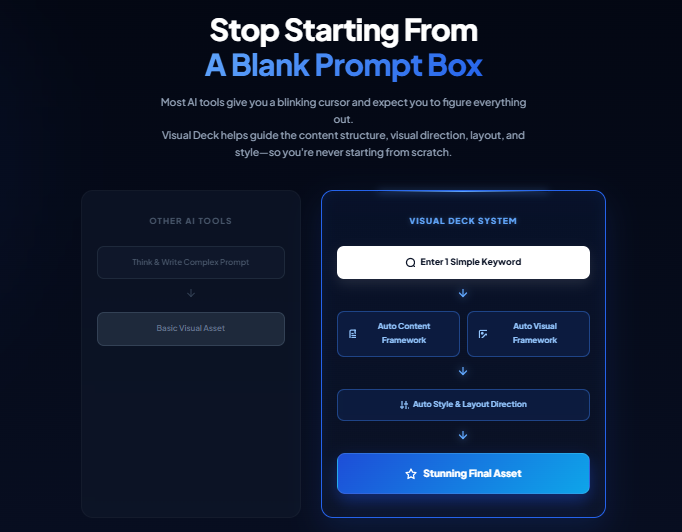
Visual Deck removes all of that decision-making from the process by generating it for you — instantly, from a single keyword input, using ChatGPT as the underlying engine with specialized visual content frameworks built on top.
Visual Deck Review 2026
What Is Visual Deck?
Visual Deck is a structured ChatGPT-based prompt and framework system — not a standalone app with a separate login — that operates through ChatGPT using specialized, professionally architected prompts built specifically for visual content planning.
You open the Visual Deck system inside ChatGPT, enter your keyword or topic, and receive a complete content framework with slide-by-slide structure, section direction, copy guidance, design notes, layout recommendations, and visual style direction — all calibrated specifically for the visual format you are building (carousel, infographic, or micro-learning sequence). The output is not a finished design. It is a complete visual blueprint: everything your designer, Canva template, or AI image tool needs to actually build the final piece without structural guesswork.
Think of it as the strategy layer that sits between a topic idea and the actual design execution — the layer that most creators skip entirely because it feels slow, and then wonder why their visual content underperforms.
Why Visual Content Planning Is the Most Skipped Step in Content Marketing
Here is something worth understanding before getting into the full feature breakdown, because it explains why Visual Deck exists and why the problem it solves is genuinely significant.
Creating visual content without a framework is like writing a book without an outline. You might produce something technically complete, but it probably wanders. The hook does not land hard enough. The middle slides do not build a satisfying progression. The final slide leaves viewers without a clear reason to save or share. And the design choices feel inconsistent because they were not planned against a coherent direction.
The most effective carousels, infographics, and micro-learning sequences are all built on intentional structure: a specific opening hook mechanism, a middle section organized around a named framework (comparison, step-by-step, mistake-and-fix, myth-and-truth, list-and-expand), and a closing that rewards the viewer for reaching the last slide. Getting that structure right requires content strategy knowledge and visual communication experience that most creators are still building while they are also trying to produce content consistently.
Visual Deck packages that structural knowledge into a system that any creator can access in seconds, applied specifically to their topic, in the format they are building, every time they need it.
Video Demo and Walkthrough
— watch the complete workflow: opening the Visual Deck system in ChatGPT, entering a keyword like “morning routine for productivity,” selecting the carousel framework, and receiving the complete output — slide count recommendation, hook slide direction, middle slide structure using a named framework, copy direction for each slide, design tone and color palette guidance, visual hierarchy notes, and the closing CTA slide strategy. Also watch the infographic framework output and the micro-learning sequence blueprint for the same keyword, showing how each format produces a different but equally structured visual plan.)
What Is Inside Visual Deck — Complete Feature Breakdown
Here is everything the Visual Deck system delivers:
Carousel Content Frameworks
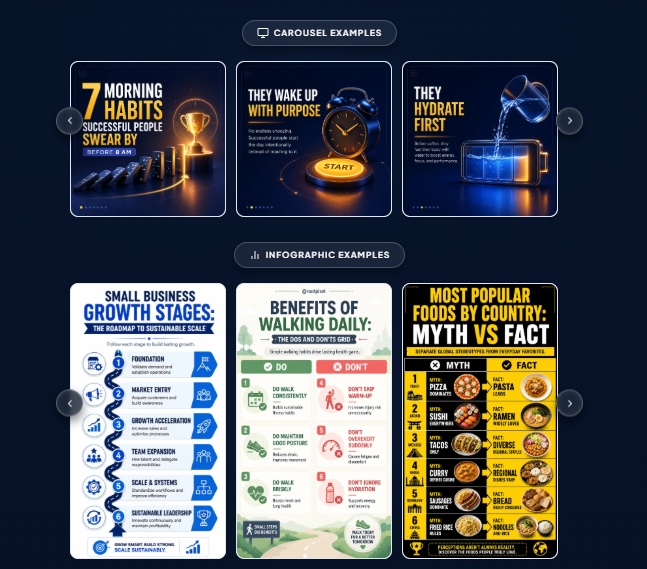
The carousel framework generator is the most immediately valuable tool inside Visual Deck for social media creators. Enter any keyword or topic and the system produces a complete carousel structure: recommended slide count for the topic complexity, hook slide concept with specific opening mechanisms tested for scroll-stopping performance, a middle section organized around the most appropriate content framework for that specific topic, slide-by-slide content direction telling you what each frame should communicate, copy length guidance for each slide to prevent visual clutter, and a closing slide strategy designed to drive saves, follows, or link clicks.
The carousel frameworks cover every major structural format that performs well across LinkedIn, Instagram, and Pinterest: step-by-step process carousels, comparison carousels, common mistakes carousels, myth-versus-truth carousels, before-and-after carousels, list expansion carousels, and story-based educational carousels. The system identifies which framework best fits your specific keyword and builds the structure around it rather than applying a generic template to every topic.
Infographic Visual Blueprints
The infographic planner is where Visual Deck separates itself most clearly from basic ChatGPT prompts for content creation. Infographics are structurally more complex than carousels — they present information in spatial relationships rather than linear slide sequences, which means the layout planning requires a different kind of decision-making.
Visual Deck generates complete infographic blueprints: the central organizing concept that the infographic communicates, the section structure and hierarchy, the spatial layout direction (vertical flow, hub and spoke, comparison grid, timeline, process map), specific data points or content elements for each section, icon and visual element suggestions by section, and copy direction for headlines and supporting text. The output gives your designer or Canva template everything needed to build the infographic without any back-and-forth on structure.
Micro-Learning Visual Sequence Planning
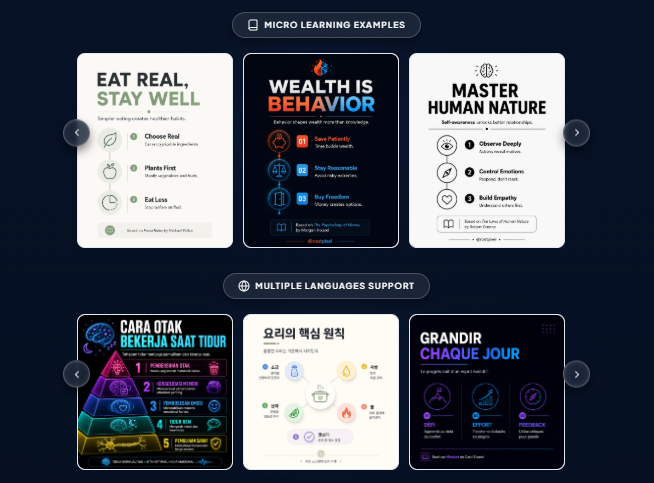
Micro-learning content — short, structured educational visual sequences typically running three to eight slides or frames — is one of the highest-engagement formats on LinkedIn, Instagram, and educational platform social feeds in 2026. The format is used by educators, coaches, consultants, course creators, and corporate training teams to deliver focused, digestible lessons in visual form.
Visual Deck’s micro-learning planner generates complete sequence blueprints: the single learning objective the sequence delivers, the content broken into appropriately sized individual frames, the progression logic connecting each frame to the next, the visual style direction appropriate for educational content in the subject area, and the knowledge confirmation element at the final frame that reinforces retention. For educators and coaches who produce micro-learning content consistently, this framework tool reduces the planning time for each sequence from 30 to 60 minutes to under five minutes.
Design Direction Outputs — Color, Style, and Visual Tone
Visual content planning that stops at content structure and ignores design direction leaves creators with half a solution. You can have a perfectly structured carousel with slide-by-slide copy direction, but if the visual execution does not match the tone of the content — if a high-energy motivational carousel is designed in muted corporate greys, or a calming wellness infographic uses aggressive high-contrast colors — the message is undermined by the visuals regardless of content quality.
Visual Deck includes design direction in every output: color palette guidance calibrated to the topic category and target audience tone, typography style direction, visual element recommendations (icons versus photography versus illustration), spacing guidance for readability, and contrast notes. These outputs give your designer a complete creative brief rather than just a content outline.
Multi-Format Output From One Keyword
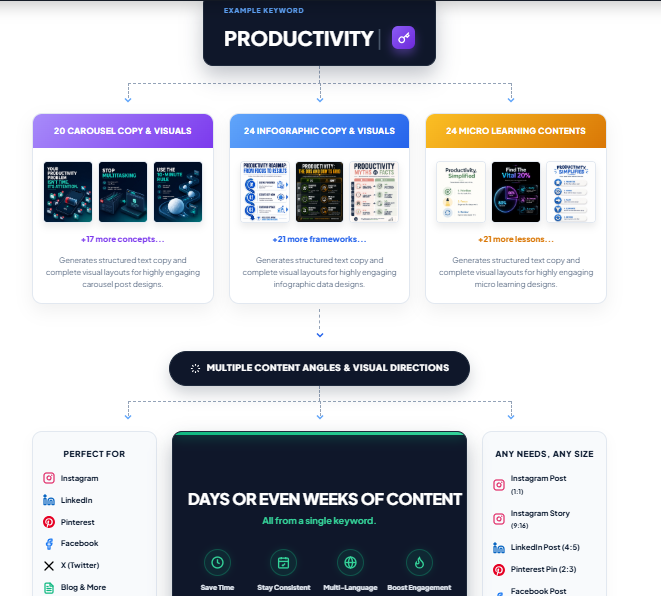
The same keyword input generates frameworks for multiple visual formats in one session. A keyword like “email marketing for beginners” produces a carousel framework, an infographic blueprint, and a micro-learning sequence plan — three distinct visual content pieces, each structured for its format, each ready for production.
For content calendar management, this multi-format output from a single keyword input is how you turn one research effort into a week’s worth of visual content across multiple platforms without needing separate planning sessions for each format or each platform.
Ready-to-Build Output — Not Just Ideas
The important distinction between Visual Deck and simply asking ChatGPT to “make me a carousel about X” is the specificity and production-readiness of the output. A generic ChatGPT carousel prompt gives you broad ideas. Visual Deck’s structured framework system gives you a precise, production-ready blueprint with specific copy direction, layout instructions, design guidance, and structural rationale for each decision.
The output is designed to go directly to a designer, a Canva template selection, a design AI tool, or your own design workflow without any additional strategic interpretation. The thinking is already done. You execute.
Visual Deck Review 2026
Visual Deck Review 2026
Visual Deck Review 2026
How to Use Visual Deck — Complete Workflow
Here is the full process from keyword to production-ready visual blueprint:
Step 1: Open Visual Deck inside ChatGPT. Access the Visual Deck system through ChatGPT. No separate platform login required. The system works within your existing ChatGPT access.
Step 2: Enter your keyword or topic. Type the subject you want to create visual content about. Be as specific or as broad as your content goal requires — “productivity habits,” “beginner investing,” “email deliverability,” “postpartum nutrition,” “SaaS onboarding best practices” — the system adapts to any topic category.
Step 3: Select your visual format. Choose carousel, infographic, micro-learning sequence, or request all three formats in one output. The system applies the appropriate structural framework for each selected format.
Step 4: Review the complete blueprint. Read through the full output — slide-by-slide structure, copy direction, design guidance, visual element recommendations, and color and style direction. The blueprint is typically complete enough for production without any follow-up questions.
Step 5: Take the blueprint to production. Hand off the blueprint to a designer with the complete creative brief already written. Or open your Canva template and build directly from the slide-by-slide content direction. Or feed the design direction into an AI image tool for visual generation. Production begins immediately without any structural planning time.
Step 6: Repeat across your entire content calendar. Run the workflow for every keyword in your content plan. With Visual Deck handling the framework generation, the bottleneck in your visual content production moves from planning to execution — which is the faster and more enjoyable part of the process for most creators.
Visual Deck OTO Upgrades — All Options Explained
The front-end delivers the core carousel, infographic, and micro-learning framework system. OTO upgrades extend the output depth, platform reach, and commercial capability of the system:
OTO 1 — Expanded Framework Library
An extended library of specialized visual frameworks covering additional content categories and formats — including data visualization planning, comparison content deep-dives, authority-positioning content sequences, storytelling visual frameworks, and platform-specific formats for Pinterest, TikTok, and YouTube community posts. For creators producing visual content across more than two or three content categories regularly, this expansion significantly broadens the range of structured outputs available without needing to manually customize the base framework system.
OTO 2 — Agency and Client Edition
Commercial rights to use Visual Deck’s output for client projects, with additional client-briefing output formats — structured creative briefs ready for handoff to client design teams, design agency partners, or in-house creative departments, formatted for professional project documentation standards. For freelancers managing social media content for multiple clients and agencies delivering content strategy and visual asset planning services, this upgrade provides the infrastructure to scale Visual Deck output into a billable service.
OTO 3 — Video Script Visual Framework Edition
Extends the visual planning capability from static formats (carousels, infographics, micro-learning slides) into video content — generating visual framework plans for short-form video scripts, YouTube educational segment structuring, Reel and TikTok content planning, and video-format micro-learning sequences. For creators producing both static and video content from the same topic strategy, this upgrade provides unified visual planning across all formats in a single session.
Which upgrades make the most sense? For individual creators, the Expanded Framework Library (OTO 1) extends the base system into more specialized content types without requiring a separate workflow. For agency owners and freelancers billing clients for content strategy and visual planning work, the Agency Edition (OTO 2) is the priority upgrade — it transforms Visual Deck from a personal productivity tool into a client service delivery asset.
How to Make Money With Visual Deck
Here are the most direct income paths:
Offer visual content planning as a social media service. Every business running an active LinkedIn, Instagram, or Pinterest account has ongoing demand for carousel and infographic content. Most do not have the internal resources to plan and design it consistently. With Visual Deck handling the framework generation, you can offer a “visual content blueprint” service — delivering structured content plans with carousel frameworks, infographic blueprints, and design direction — charging $150 to $500 per content calendar batch. The actual production time per piece is under five minutes.
Scale your own content output and grow your social following. For creators monetizing through affiliate marketing, digital product sales, course enrollment, or coaching, consistent high-quality visual content is one of the fastest levers for audience growth. Carousels and infographics that are structurally strong generate saves, shares, and profile visits that compound into follower growth. Visual Deck lets you maintain the publishing frequency and content quality that drives that growth without the planning bottleneck that slows most creators down.
Create and sell infographic and micro-learning content packs. Niche-specific visual content packs — “30 finance micro-learning sequences,” “20 wellness infographic blueprints,” “15 marketing carousel frameworks” — are a sellable digital product to creators and small business owners who want ready-to-build visual content structures without the planning work. Visual Deck generates the raw material for these packs at scale, making it practical to build and sell specialized visual content framework libraries.
Visual Deck Key Features
Visual Deck Review 2026
Frequently Asked Questions
Is Visual Deck a separate app or does it work inside ChatGPT?
Visual Deck operates as a structured framework system inside ChatGPT — you use it through your existing ChatGPT access without downloading a separate application or managing another platform login.
Do I need design skills to use Visual Deck?
No. Visual Deck generates the planning and blueprint layer — content structure, layout direction, design guidance, and copy direction. You take that blueprint to whatever design tool you use: Canva, Adobe Express, a hired designer, or an AI image generator. The structural thinking is handled for you.
What social media platforms is Visual Deck most useful for?
The carousel frameworks are optimized for LinkedIn, Instagram, and Pinterest. The infographic blueprints work across all platforms and for website and blog use. The micro-learning sequences are designed for LinkedIn, Instagram, and educational platform social feeds.
How long does it take to generate a complete visual blueprint?
Typically two to five minutes from entering your keyword to receiving a complete, production-ready blueprint for your chosen visual format.
Can I use Visual Deck for client work?
The base front-end is designed for personal use. The OTO 2 Agency and Client Edition adds commercial rights and client-facing briefing formats for professional service use.
What are the Visual Deck OTO upgrades?
Three upgrades: Expanded Framework Library for broader content category coverage, Agency and Client Edition for commercial and client service use, and Video Script Visual Framework Edition for video content planning.
Does Visual Deck work for any niche?
Yes. The framework system applies to any topic category — business, health, finance, education, technology, lifestyle, food, travel, parenting, and more. The specialized structure is applied to whatever keyword you enter.
Final Thoughts
Visual content is not going anywhere. If anything, the platforms are rewarding it more consistently than ever — carousels earn more algorithmic distribution than single images, infographics earn more shares than plain text posts, and micro-learning sequences are building some of the most engaged professional audiences on LinkedIn and Instagram right now.
The creators consistently winning with visual content are not necessarily the best designers. They are the ones with the strongest content structure — the ones whose carousels have genuinely compelling hooks, whose infographic layouts communicate information clearly rather than just looking busy, whose micro-learning sequences leave viewers with something they actually learned and want to share.
Visual Deck is the system that gives any creator that structural advantage — keyword in, complete blueprint out, production begins immediately. For anyone who creates visual content regularly and has ever sat staring at a blank slide trying to figure out where to start, this is the tool that solves that specific problem every single time.