Peptides are tiny but powerful molecules that control nearly every function in your body — from healing wounds to slowing aging. This beginner’s guide breaks it all down in plain English.
What Are Peptides? A Beginner’s Guide to How They Work in Your Body
Peptides are everywhere right now — gym locker rooms, skincare counters, biohacking forums, anti-aging clinics. But most people still have no idea what they actually are or what they do inside your body. If you have been seeing the word pop up and quietly wondering what the fuss is about, this guide is for you.
No textbook language. No confusing science jargon. Just a straight, honest breakdown of what peptides are, how they work, and why they matter — whether you are into fitness, skincare, longevity, or just curious about your own biology.
So, What Exactly Is a Peptide?
Here is the simplest way to think about it.
Your body is built from proteins. And proteins are built from smaller units called amino acids. Now, when you link a small number of those amino acids together — anywhere from 2 to about 50 — that chain is called a peptide.
Think of amino acids as individual Lego bricks. A full protein is like a massive Lego castle — complex, large, and detailed. A peptide is more like a small Lego structure, maybe 5 to 20 bricks snapped together. Smaller, simpler, but still purposeful.
The reason that size difference matters is huge. Smaller chains can move through tissue faster, bind to cell receptors more easily, and trigger very specific reactions inside your body. That is exactly why peptides are so interesting to researchers, doctors, and everyday people trying to optimize their health.
Your body already produces thousands of different peptides naturally. Insulin — the hormone that controls your blood sugar — is a peptide. So are endorphins, the natural painkillers your brain releases after a hard workout. Oxytocin, sometimes called the “bonding hormone,” is a peptide too.
How Do Peptides Actually Work?
This is where it gets genuinely fascinating.
Peptides work like chemical messengers. They travel through your bloodstream or tissue, find specific receptor sites on the surface of cells, and lock in. When that connection happens, it triggers a chain reaction inside the cell — what scientists call a signaling cascade.
Picture a key and a lock. The peptide is the key. The cell receptor is the lock. When the right key slides into the right lock, something specific happens — a door opens, a process starts, a signal fires.
That “something specific” depends entirely on the peptide. Some peptides tell your cells to produce more collagen. Others instruct your pituitary gland to release growth hormone. Some reduce inflammation. Others accelerate tissue repair. Each one has a distinct job, and they are remarkably precise at doing it.
This specificity is a big part of why the research world is so excited about peptides. Unlike broad-acting compounds that affect many systems at once, peptides tend to target exactly what they are designed to target — with minimal interference elsewhere.
Check Here:
“Your body already uses peptides every day — find out which ones actually work for you.“

What Are Peptides? A Beginner’s Guide to How They Work in Your Body
Where Do Peptides Come From?
Your body makes them constantly. When you eat protein — chicken, eggs, fish, legumes — digestive enzymes break that protein down into smaller pieces. Some of those pieces are individual amino acids. But some are small peptide chains that get absorbed intact through your intestinal lining and go on to perform biological functions before being broken down further.
This is part of why protein quality matters. Different protein sources produce different peptide profiles during digestion, which may explain why whole food sources often outperform synthetic protein isolates in certain health outcomes. Research published in NIH journals has highlighted how food-derived peptides play a meaningful role in gut health, metabolic function, and nutrient absorption.pmc.ncbi.nlm.nih+1
Beyond food, peptides can also be produced synthetically in labs. Researchers synthesize specific peptide sequences to study how they interact with the body — mimicking natural processes or triggering ones the body may no longer produce efficiently due to age, injury, or illness.
The Main Types of Peptides You Should Know
Not all peptides do the same thing. Here is a quick breakdown of the major categories:
Signaling Peptides
These act as biological alerts. They tell specific cells when to activate, when to repair, when to produce something, and when to stop. Insulin is a perfect example — it signals your cells to absorb glucose from the bloodstream.
Hormonal Peptides
These regulate core body functions like metabolism, growth, stress response, and reproductive health. Growth hormone-releasing peptides fall into this category, which is why they attract so much interest in fitness and anti-aging research.
Structural Peptides
These contribute to the physical integrity of tissues. They are not as large as full proteins but they support the framework of skin, connective tissue, and joints — which is why collagen peptides became a massive trend in the wellness space.
Carrier Peptides
These transport essential molecules — like copper or zinc — directly into the cells that need them. GHK-Cu (copper peptide) is a well-studied carrier peptide known for its role in skin repair and wound healing.
Antimicrobial Peptides
These are part of your immune system’s first line of defense. They can destroy bacterial cell walls and have attracted attention in pharmaceutical research as potential alternatives to traditional antibiotics.
Bioactive Peptides
These have highly specific biological actions depending on their structure. Bioactive peptides derived from food sources have shown antioxidant, anti-inflammatory, and antihypertensive properties in research settings.
What Can Peptides Do for Your Health?
This is the question most people actually want answered. Here is what current research shows:
Muscle Recovery and Growth
Certain peptides stimulate the release of growth hormone, which plays a central role in muscle repair and development. BPC-157, for example, has shown strong results in animal studies related to tendon healing, tissue repair, and injury recovery. Researchers and athletes have taken significant interest in it for this reason.
Skin and Anti-Aging
Collagen makes up roughly 75% of your skin’s structure, and peptide signals tell your skin cells to keep producing it. As you age, that signaling slows down. Research peptides like GHK-Cu have demonstrated improvements in skin elasticity and wound healing in clinical topical studies.
Hormone Regulation
Peptides like CJC-1295 and Ipamorelin are growth hormone secretagogues — meaning they prompt the pituitary gland to release more growth hormone naturally, rather than introducing synthetic hormones directly. Small human trials have shown increases in IGF-1 levels up to three times baseline.
Immune Support
Antimicrobial peptides are a natural part of your immune response and researchers are actively studying synthetic versions as next-generation treatments for bacterial infections that have grown resistant to conventional antibiotics.
Gut Health and Metabolism
Food-derived peptides have been shown to support the intestinal epithelial barrier, reduce gut permeability, and improve nutrient absorption — all factors that connect directly to metabolic health and inflammation.
Check Here:
“99%+ purity or it does not count. See the peptides researchers actually trust.“

What Are Peptides? A Beginner’s Guide to How They Work in Your Body
Peptides vs. Proteins: What Is the Actual Difference?
People often mix these up, and the line is genuinely blurry. The technical distinction comes down to chain length. A peptide is typically 2 to 50 amino acids. A protein is a longer chain — usually more than 50 amino acids — that folds into a complex three-dimensional structure.
Functionally, proteins tend to serve structural or enzymatic roles (think muscle fibers or digestive enzymes), while peptides more often serve as signaling or regulatory molecules. That said, many proteins contain peptide sequences within them, and some peptides behave like mini-proteins in biological terms.
The practical takeaway: peptides are smaller, more targeted, and often more bioavailable than full proteins — which is a major reason they have attracted so much attention in medical and wellness research.
Are Peptides Safe?
The safety of any peptide depends entirely on which one you are talking about, how it is sourced, and what it is being used for.
Peptides naturally produced by the body — like insulin or endorphins — are well-understood and essential to life. Food-derived peptides from digesting proteins are safe and consumed every day.
Synthetic research peptides are a different category. Many are still in experimental stages, with strong animal data but limited large-scale human trials. The key factors are purity, dosage, and context. An impure peptide product can produce unpredictable results regardless of what the compound itself is meant to do.
This is why product purity is not a minor detail — it is the whole game. Impurities in peptide synthesis can include deletion sequences, incomplete deprotection byproducts, and chemical residues from the manufacturing process. These contaminants compromise results and raise safety concerns.
Why Peptide Purity Is Everything
If you are exploring research peptides, the single most important factor to evaluate is purity.
A peptide rated at 99%+ purity has had virtually all synthesis byproducts removed. This matters because even small amounts of impurities can interfere with receptor binding, alter research outcomes, or introduce unwanted biological activity. For serious research, you want a compound that is exactly what it says it is — nothing added, nothing missing.
This is where supplier quality becomes non-negotiable. Researchers need to know they are working with rigorously tested compounds, not something mixed in a garage lab with no quality controls.
Where Researchers Source High-Quality Peptides
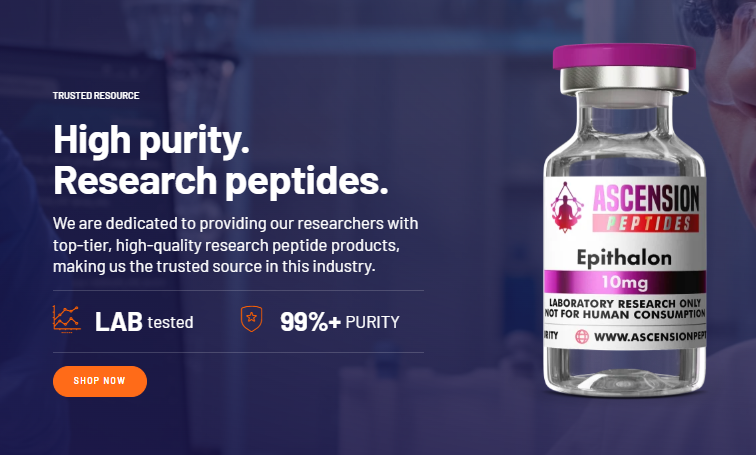
For U.S.-based researchers looking for reliable, lab-tested peptide products, Ascension Peptides has built a reputation as one of the more trusted sources in the space.
They offer a wide range of peptides with 99%+ purity, verified through standard peptide purity analysis. Their products are designed for research use and shipped within the United States. They also offer peptide blends — targeted formulas that combine multiple peptides for synergistic research applications — as well as volume pricing for wholesalers and distributors who need consistent supply at scale.
If you take the science seriously, you need a supplier who does too.
Check Here:
“Stop guessing. Start researching with peptides that are tested, verified, and ready to ship.“

What Are Peptides? A Beginner’s Guide to How They Work in Your Body
Frequently Asked Questions
What is the simplest way to explain a peptide?
A peptide is a short chain of amino acids — smaller than a protein but built from the same raw materials. Your body uses peptides as chemical messengers to control processes like healing, hormone release, and immune response.
Are peptides the same as proteins?
No. Peptides are shorter chains (2–50 amino acids). Proteins are larger, more complex structures. Functionally, peptides tend to act as signals while proteins tend to act as structural or enzymatic agents.
Do peptides work for skin?
Yes. Certain peptides, especially collagen-stimulating and copper peptides, have strong supporting evidence in skin elasticity, wound healing, and anti-aging research — both in topical and injectable forms.
Are research peptides legal?
In the U.S., many research peptides exist in a legal gray area — legal to purchase and possess for research purposes but not approved by the FDA for human therapeutic use. Always verify the legal status of specific compounds in your region.
How do I know if a peptide product is high quality?
Look for verified purity certificates (HPLC testing), transparent manufacturing practices, and third-party lab verification. Any reputable supplier should be able to show you exactly what is in their product.
Do I need to inject peptides or can I take them orally?
It depends on the peptide. Many research peptides are administered via subcutaneous injection because the digestive process can break them down before absorption. Some peptides, however, are designed to survive digestion or are used topically.
Peptides are not hype. They are fundamental to how your body operates — from the moment you wake up to the moment your cells are repairing themselves while you sleep. The growing interest in research peptides is simply a reflection of what science has been pointing to for decades: these small molecules have enormous influence over human physiology.
If you are serious about exploring what specific peptides can do — whether for recovery, performance, or longevity research — the starting point is always the same. Find a source you can trust. One with documented purity, legitimate lab testing, and a track record in the research community.
That is exactly what Ascension Peptides was built for.
Check Here:
“The science is clear. The source matters. Explore Ascension Peptides today.“