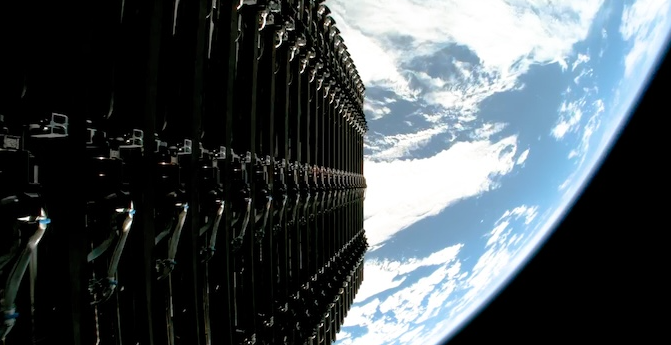
SpaceX Starlink Group 17-24 launch from Vandenberg on March 16, 2026 put 25 next-generation V2 Mini satellites into low Earth orbit — and the same night, SpaceX crossed 10,000 simultaneous active Starlink satellites for the first time in history. Here is the full story.
SpaceX Launches 25 Starlink Satellites From Vandenberg on Falcon 9 — And Hits 10,000 in Orbit the Same Night
SpaceX’s Starlink Group 17-24 launch from Vandenberg Space Force Base on the night of March 16, 2026 was, on the surface, another successful routine mission in a year that has already delivered dozens of them. A Falcon 9 rocket lifted off from Space Launch Complex 4 East at 10:19 p.m. PT, carried 25 next-generation Starlink V2 Mini satellites into low Earth orbit, and the first-stage booster came back down and nailed its drone ship landing in the Pacific Ocean exactly as planned. Clean launch, clean deployment, clean recovery. By SpaceX’s current operational standards, nothing unusual.
Except that this particular mission pushed something that had never happened before. By the time those 25 satellites began their orbital drift toward their designated positions later that night, SpaceX crossed 10,000 simultaneous Starlink satellites in orbit for the first time in history. That number — which would have seemed like science fiction ten years ago — is now a verified operational milestone that fundamentally changes what the Starlink network is capable of delivering to the people using it on the ground.
Here is the full story of what happened, what it means, and where SpaceX is going next.
The Launch: Everything That Happened on March 16
The Starlink Group 17-24 mission lifted off from SLC-4E at Vandenberg Space Force Base in California on schedule. The launch window had opened at 10:16 p.m. PT and the rocket left the pad just minutes later, arcing southward over the Pacific on a trajectory designed to deliver the satellites to their target orbital plane in low Earth orbit.
The Falcon 9 first-stage booster that flew this mission was not new hardware. It had flown multiple previous missions and performed exactly as the reusability track record of Falcon 9 would predict — reliable enough that the pre-launch commentary around it focused far more on the milestone the payload would help achieve than on the rocket itself. About eight and a half minutes after liftoff, the booster separated from the upper stage, re-entered the atmosphere, and touched down successfully on SpaceX’s drone ship stationed in the Pacific Ocean. The landing was nominal, another data point in what is now an extremely long series of successful Falcon 9 booster recoveries.
The upper stage continued on its mission, delivering all 25 Starlink V2 Mini satellites into their low Earth orbit deployment altitude. SpaceX confirmed deployment on social media shortly after, with the standard confirmation that has become familiar to anyone who follows the company’s launch coverage: “Deployment of 25 Starlink satellites confirmed.”
What followed that confirmation was the number that made the night notable.
=> SpaceX just hit 10,000 satellites in orbit. The fastest-growing internet network in history is now covering your area. Check Starlink availability and sign up today.

SpaceX Launches 25 Starlink Satellites
The Milestone: 10,000 Starlink Satellites in Orbit
With the Group 17-24 satellites on their way to operational altitude, SpaceX’s constellation crossed 10,000 simultaneous active Starlink satellites in orbit for the first time. The milestone was noted specifically in Spaceflight Now’s coverage, which tracked the headline alongside its standard launch documentation for the mission.
The scale of that number is worth sitting with for a moment because it does not land intuitively. Ten thousand individual spacecraft, each one roughly the size of a dining table, moving in coordinated orbital patterns across multiple altitude bands above the Earth, collectively forming a broadband internet network that can reach virtually any point on the planet’s surface. The entire constellation communicates continuously — both with user terminals on the ground and with each other through inter-satellite laser links that allow data to route across the network without touching ground stations between hops.
The path to 10,000 was a story of relentless launch cadence. SpaceX launched its 600th Starlink satellite of 2026 in early March — a pace that works out to roughly 75 satellites per week through the first quarter of the year. In the weeks immediately surrounding the March 16 launch, SpaceX executed missions from both Vandenberg and Cape Canaveral on near-overlapping schedules, with a 25-satellite Vandenberg mission on March 13, a 29-satellite Cape Canaveral mission on March 14, and the Group 17-24 mission on March 16. Three launches carrying more than 75 satellites in four days — that is the operational tempo SpaceX is maintaining in 2026.
What 10,000 Satellites Actually Changes for Users
More satellites in the right orbital positions means more capacity, more redundancy, and lower latency for the people using Starlink on the ground. Each additional satellite is not just a backup — it actively expands the network’s ability to handle simultaneous connections and improves the geometry between user terminals and the constellation overhead at any given moment.
The V2 Mini satellites that have been flying on Falcon 9 missions throughout 2025 and into 2026 are a significant step up from the original Starlink design. Each V2 Mini carries roughly four times the capacity of the original V1 satellites. The constellation reaching 10,000 active units — a mix of updated V2 Mini hardware and earlier generation satellites still in operation — means the aggregate capacity of the network is substantially higher than the simple satellite count alone suggests.
For Starlink users in North America, Europe, and other heavily served regions, the practical effect is already showing up in performance metrics. Users in areas that previously experienced congestion during peak evening hours are reporting more consistent speeds as the constellation density in those orbital planes increases. For maritime users, aviation customers, and enterprise operators in remote locations, the higher satellite density means more consistent coverage and stronger signal geometry throughout the day.
The latency story is also improving steadily. Low Earth orbit internet has always had an inherent latency advantage over geostationary satellites, which sit roughly 35,000 kilometers above the equator and impose a roughly 600-millisecond round-trip delay that makes real-time applications like video calls and gaming nearly unusable. Starlink’s constellation operating at altitudes between 540 and 570 kilometers achieves typical latency in the 20 to 40 millisecond range — competitive with many ground-based broadband providers and far ahead of traditional satellite internet.
Starlink V2 Mini: What These Satellites Are and Why They Matter
The 25 satellites deployed on the Group 17-24 mission were Starlink V2 Mini — the current standard payload for Falcon 9-based Starlink missions. The “Mini” designation reflects that these are a smaller version of the full V2 Starlink design that SpaceX is developing for deployment on Starship, but they are substantially more capable than the original V1 satellites that built the early constellation.
Each V2 Mini operates with argon-based Hall-effect thrusters for orbital maneuvering, an improvement over the krypton thrusters used in earlier generations that offers better efficiency and longer operational life. They carry E-band antenna arrays that significantly increase the radio frequency bandwidth available per satellite, which is what translates directly to the higher capacity figures.
The V2 Minis also support direct-to-cell service — the capability that allows Starlink to deliver connectivity directly to standard smartphones without specialized hardware, using partnerships with mobile network operators including T-Mobile in the United States. This feature has been rolling out in limited form and is expected to expand significantly in coverage and capability as the V2 Mini population grows and as software updates enable more of the constellation to support the service.
The Bigger Picture: SpaceX’s 2026 Launch Pace and What Comes Next
The March 16 launch was one piece of a launch cadence that is, by any historical standard, extraordinary. SpaceX entered 2026 operating simultaneously from both coasts of the United States, launching Falcon 9 rockets from Vandenberg Space Force Base in California and from Space Launch Complex 40 at Cape Canaveral Space Force Station in Florida, as well as occasional missions from the Kennedy Space Center’s Launch Complex 39A.
SpaceX’s 2026 Starlink launch schedule has been averaging multiple missions per week. The February through March period alone saw dozens of missions carrying hundreds of satellites — building on a 2025 cadence that had already established new records for annual launch frequency by a single operator.
The next major step is Starship. SpaceX has been developing the full V3 Starlink satellite design specifically for deployment on Starship, which has the payload capacity to carry approximately 60 satellites per flight compared to the 25 to 29 carried by Falcon 9 on Starlink missions. SpaceX has stated that each Starship-based V3 Starlink launch will add more than 60 terabits per second of network capacity — more than 20 times the increase from a single Falcon 9 Starlink mission. The V3 satellites themselves are designed with more than one terabit per second of downlink capacity each, roughly a 10x improvement over the V2 Mini design, along with a 24x improvement in uplink capacity.
When V3 Starlink deployments begin at scale on Starship, the network’s capability will step up in a way that makes the 10,000-satellite milestone look like the beginning rather than the ceiling.
Booster Reusability: The Economics Behind the Cadence
One thing that makes SpaceX’s launch cadence economically sustainable — and that the broader space industry has not yet replicated — is the booster recovery and reuse program. The Falcon 9 first stage that flew the Group 17-24 mission had flown multiple times before and will be refurbished and flown again. SpaceX’s drone ships in both the Pacific and Atlantic oceans operate as floating landing pads, recovering boosters from both coasts and returning them to launch sites for processing.
The economics of this are substantial. A new Falcon 9 first stage costs in the range of tens of millions of dollars to manufacture. Recovering, inspecting, and refurbishing a used booster costs a fraction of that. SpaceX’s ability to launch at the current cadence without the unit economics becoming prohibitive is directly tied to how many times each booster can fly — a number that has been increasing steadily, with some boosters now having completed more than 20 missions. Some Starlink-dedicated boosters have flown over 25 individual missions, demonstrating a reliability track record that would have seemed implausible for orbital-class rocket hardware a decade ago.
That reusability flywheel — lower cost per launch, more launches possible, more revenue and data to fund further development — is what makes the 10,000-satellite milestone achievable in the timeline SpaceX has executed.
FAQ
When did SpaceX reach 10,000 Starlink satellites in orbit?
SpaceX crossed 10,000 simultaneous Starlink satellites in orbit on March 16, 2026, following the successful deployment of 25 V2 Mini satellites from the Starlink Group 17-24 mission launched from Vandenberg Space Force Base.
What are Starlink V2 Mini satellites?
Starlink V2 Mini are the current generation of Starlink satellites flown on Falcon 9 rockets. They offer approximately four times the capacity of the original V1 design, use argon-powered Hall-effect thrusters, and support direct-to-cell connectivity for standard smartphones.
Where did the March 16, 2026 Starlink launch take off from?
The launch took place from Space Launch Complex 4 East (SLC-4E) at Vandenberg Space Force Base in California at 10:19 p.m. PT.
Did the Falcon 9 booster land successfully?
Yes. The first-stage booster landed successfully on SpaceX’s drone ship in the Pacific Ocean approximately eight and a half minutes after liftoff.
How many Starlink satellites has SpaceX launched in 2026?
SpaceX launched its 600th Starlink satellite of 2026 in early March and has continued at a pace of multiple missions per week throughout the year’s first quarter.
What comes after V2 Mini Starlink satellites?
SpaceX is developing V3 Starlink satellites for deployment on the Starship launch vehicle. Each V3 satellite is expected to deliver more than 1 terabit per second of downlink capacity — a 10x improvement over V2 Mini — and each Starship mission will add more than 60 Tbps of network capacity, over 20 times the improvement of a single Falcon 9 Starlink launch.
How does Starlink’s latency compare to traditional satellite internet?
Traditional geostationary satellite internet has a round-trip latency of roughly 600 milliseconds. Starlink, operating in low Earth orbit, typically delivers latency between 20 and 40 milliseconds — competitive with many fixed broadband providers.
Ten thousand satellites in orbit is a number that represents years of engineering, thousands of launches, hundreds of booster recoveries, and a pace of execution that no other organization in the history of spaceflight has come close to matching. Starlink is no longer a promise about future internet coverage. It is operational infrastructure serving millions of users in some of the most remote and underserved corners of the planet right now. If you are in a location where traditional broadband is limited, unreliable, or simply unavailable, Starlink’s growing constellation means the coverage, speed, and reliability picture is improving with every mission. Check availability for your address today — the network reaching you in the sky just got bigger.
=> No cables. No towers. Just 10,000 satellites overhead and internet that actually works wherever you are. Get Starlink now before your area fills up.